

August Lawn Care in North Carolina: How to Prep Now for Fall Sod Installation
August 3, 2026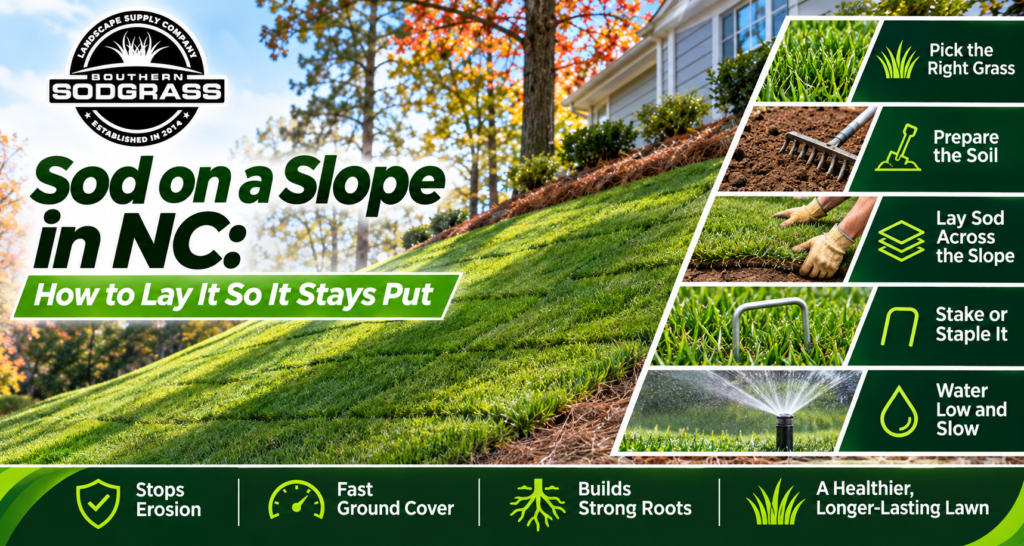
If you have a bank in your yard that turns into a mud slide every time it rains, you’re not alone. Central North Carolina is rolling Piedmont country, and plenty of homes in Greensboro, Winston-Salem, and the Triangle sit on lots with a hill out back or a steep strip along the driveway. Bare dirt on a slope doesn’t stay put for long.
The good news is that laying sod on a slope in NC is one of the fastest ways to stop that erosion. The catch is that a hill asks for a few extra steps that a flat yard doesn’t. Skip them and you can watch your new grass slide right down to the street after the first heavy storm.
Here’s how to do it right.
Why Sod Beats Seed on a Hill
Grass seed and slopes don’t get along. Rain washes seed downhill before it can sprout, and the bare soil keeps eroding the whole time you wait. You end up with thick grass at the bottom of the hill and gullies at the top.
Sod covers the soil the day you lay it. The North Carolina Department of Environmental Quality’s erosion control manual lists “immediate erosion and dust control” as one of the main advantages of properly installed sod, along with a lower chance of failure than seeding. That’s why you see sod on highway banks and around storm drains, not just in front yards.
Step 1: Pick the Right Grass for Your Slope
We grow and deliver three types of sod, and each one behaves a little differently on a hill.
- Bermuda: Best for sunny slopes. Bermuda spreads with runners above and below the ground, so it knits itself together and grips the soil fast. It also recovers quickly from damage.
- Zoysia: Thick and dense, which helps slow down water running across the surface. Zoysia also spreads with runners, though more slowly than Bermuda. It handles a bit more shade.
- Tall Fescue: The go-to choice for shady banks under trees and for anyone who wants green grass through the winter. Fescue grows in clumps instead of spreading with runners, so good staking and tight seams matter even more.
If you’re not sure which fits your hill, our post on the best grass to grow in North Carolina walks through sun, shade, and traffic. Or just give us a call. Helping you pick the right product is part of what we do.
Step 2: Prepare the Soil
A slope drains fast, and Piedmont red clay doesn’t help. Water hits hard clay and runs off instead of soaking in, which leaves new roots thirsty.
Before any sod goes down:
- Fill in ruts and gullies. Use good soil to smooth out the channels that erosion has already carved. If you leave them, water will keep following the same path under your new sod.
- Test your soil. A soil test from the N.C. Department of Agriculture tells you exactly how much lime and fertilizer your slope needs.
- Work in compost. The NC DEQ standard calls for mixing amendments into the top 4 to 8 inches of soil. Compost loosens clay so water can soak in and roots can grow down. We deliver Organi-Post High Grade Compost, and it can come on the same truck as your sod pallets.
- Rake it smooth and firm. You want a firm, even surface with no loose fluff on top. Loose soil slides.
Lightly wet the soil right before you start laying. Sod placed on bone-dry dirt dries out fast, especially on a hill.
Step 3: Lay Sod Across the Slope, Not Down It
This is the single most important rule. Lay each strip with its long side running across the hill, like the steps of a staircase. NC DEQ’s standard says the same thing: the longest dimension of each strip should be perpendicular to the slope.
Why does this matter so much? When strips run up and down the hill, every seam becomes a little channel. Water rushes down those gaps and washes out the soil underneath. Strips laid sideways act like small dams that slow the water down.
A few more tips for this step:
- Start at the bottom and work your way up. Each new row rests against the one below it.
- Stagger the seams in a brick pattern so no two joints line up.
- Butt the edges tight. Don’t stretch the sod to make it fit, and don’t overlap pieces.
- Use a sharp knife to trim pieces around trees, edges, and curves.
Step 4: Stake or Staple Your Sod
On a gentle roll, sod laid well will often hold on its own. On anything steeper, you need to pin it down until the roots take hold.
So how steep is “steeper”? NC DEQ says to secure sod with staples on slopes of 3:1 or greater, or anywhere erosion could be a problem. A 3:1 slope drops 1 foot for every 3 feet you walk across it. If you have to lean forward to walk up your hill, you’re probably there.
The same standard calls for staples at least 6 inches tall, placed at each corner of every piece, one in the middle, and one every foot along the uphill edge. Wooden sod stakes work too. Drive them flush with the surface so they don’t catch your mower later.
Step 5: Water Low and Slow
Watering a slope is tricky. Blast it with a sprinkler and most of the water runs straight to the bottom, taking soil with it.
- Water right after you finish. NC DEQ recommends watering until the soil is wet 4 inches below the sod. Lift a corner to check.
- Use shorter, more frequent cycles. Run the sprinkler for a few minutes, let it soak in, then run it again. This gives the clay time to absorb water.
- Watch the top of the slope. It dries out first. The bottom stays wetter, so don’t overwater it trying to keep the top green.
- Stay off the slope while the roots are knitting in. Foot traffic on wet sod can shift whole pieces.
Once the sod is rooted and resists a gentle tug, you can mow. Mow across the slope, not up and down, and never take off more than one-third of the blade at a time.
Can You Lay Sod on a Slope in NC in Late Fall?
Yes, as long as the ground isn’t frozen. In fact, late fall and winter are when a lot of bare slopes do their worst washing out, so covering that soil now beats waiting for spring.
Tall Fescue is a natural fit for cool-weather installs. Bermuda and Zoysia go dormant and brown this time of year, so for a sunny bank you’ll want to talk timing with us before you order. Either way, irrigation still matters in cold months. Sod needs water to root no matter the season.
Plan Your Slope Project With Southern Sodgrass
Getting sod on a slope in NC to stay put comes down to four things: the right grass, well-prepared soil, strips laid across the hill, and staples where the grade gets steep.
Measure your slope with our sod calculator before you order. Hills have more surface area than they look like from the road, so measure along the ground, not from the top down.
Our sod is cut to order and delivered on pallets across the Triad and Triangle, from Greensboro and High Point to Burlington, Raleigh, Durham, and Chapel Hill. You can add Organi-Post High Grade Compost to the same delivery, and we carry other landscaping materials too. Fresh sod laid quickly roots better than sod that sits around.
Ready to stop the mud? Call us at (336) 996-4SOD (4763) or request a free quote. From November through March, we’re open Monday through Friday, 8:30 a.m. to 5:00 p.m.
Frequently Asked Questions
Do I really need to stake sod on a slope?
On steep slopes, yes. NC DEQ recommends staples on slopes of 3:1 or steeper. On a gentle grade, tight seams and good watering are often enough, but staking is cheap insurance if heavy rain is in the forecast.
What’s the best grass for a hill in North Carolina?
For full sun, Bermuda is hard to beat because its runners grip the soil. For shade, Tall Fescue is usually the better choice. Zoysia works well in between.
How long until sod on a slope is rooted?
It depends on the season and the grass type. The simple test: gently tug on a corner. If it resists, the roots have grabbed hold.
Should I lay sod from the top or the bottom of the slope?
Start at the bottom and work up, laying each row across the hill with staggered seams.


